Cloud Penetration Testing Standards and Best Practices
A practical guide to cloud penetration testing standards, proven methodologies, and best practices for securing AWS, Azure, and Google Cloud.
%20(3).webp)










Why Cloud Penetration Testing Matters
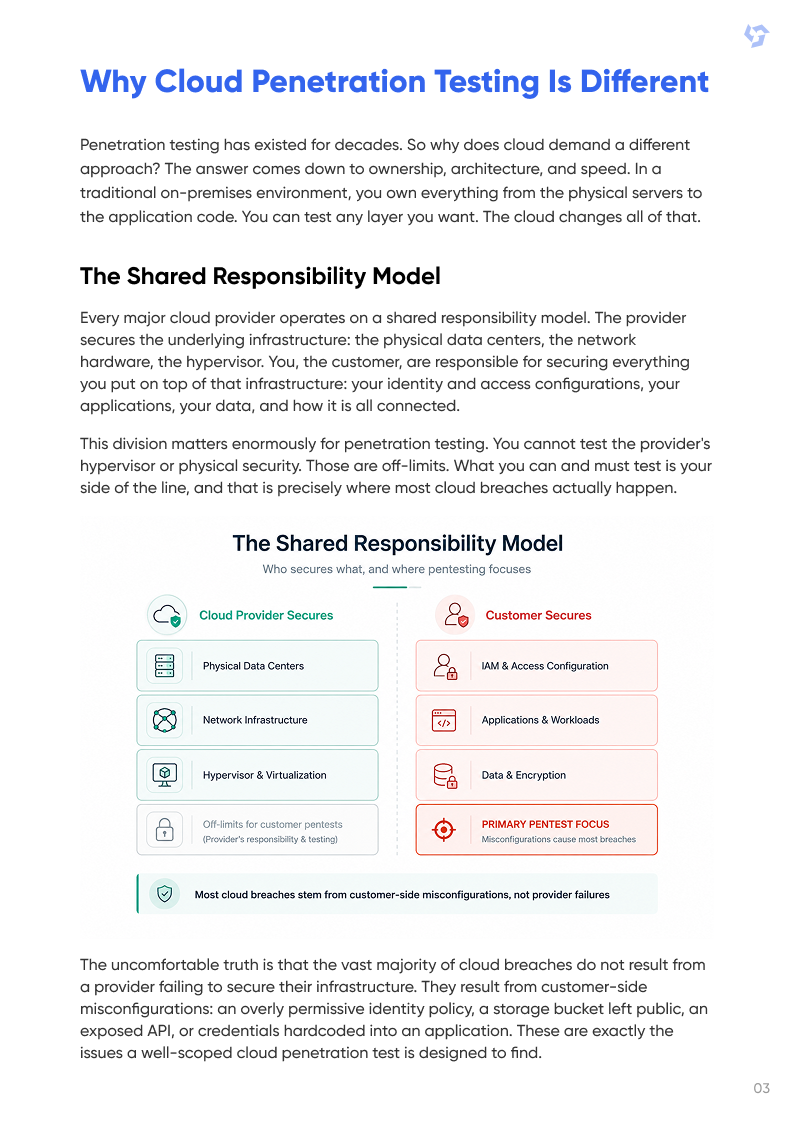
Cloud security follows a shared responsibility model, where providers secure the infrastructure while customers are responsible for protecting their applications, identities, configurations, and data.
Most cloud breaches result from customer-side misconfigurations, excessive permissions, exposed APIs, and identity weaknesses—not failures of the cloud provider. Traditional penetration testing often misses these cloud-native attack paths.
This whitepaper explains how cloud penetration testing differs from traditional assessments, the standards that guide effective testing, and the best practices for continuously validating cloud security.
Key Insights Included in the Report
1. Shared Responsibility Model: Understand what you're responsible for securing across AWS, Azure, and Google Cloud.
2. Cloud Testing Standards: Learn how PTES, NIST SP 800-115, OWASP, and MITRE ATT&CK support effective cloud penetration testing.
3. Modern Cloud Attack Surfaces: Discover how IAM, APIs, containers, Kubernetes, serverless, and cloud misconfigurations increase risk.
4. A Proven Testing Methodology: Follow a structured approach covering scoping, discovery, exploitation, reporting, remediation, and retesting.
5. Continuous Cloud Validation: Learn why continuous testing is essential for securing rapidly changing cloud environments.
.webp)
Inside the Report
A practical, data-driven roadmap to strengthen security and drive measurable outcomes.
.webp)